Training Fundamentals
How Many Sets Per Muscle Group Per Week?
Aim for 10 to 20 hard sets per muscle group per week, counting compound lifts as half a set for helper muscles. How to count yours and where to start.
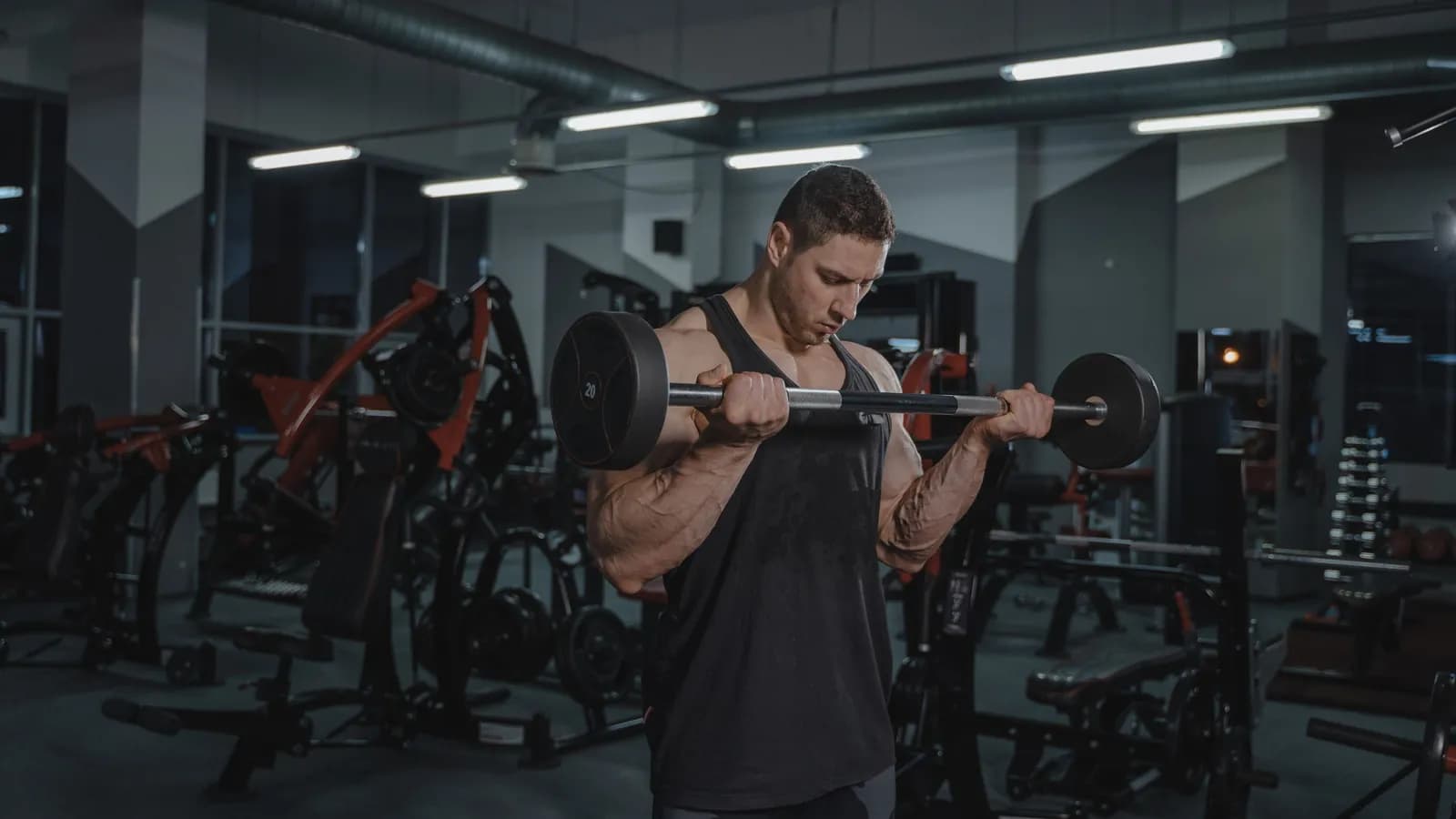
Aim for roughly 10 to 20 hard sets per muscle group per week. If you're new to lifting, 4 to 10 is enough to grow. One detail changes the math: a compound lift only counts as half a set for the muscles that assist it, so a set of bench press is a full set for your chest but half a set for your triceps.
That half-set rule comes from a large dose-response meta-analysis published in Sports Medicine that pooled 67 studies and 2,058 people. It also found that more sets keep adding muscle well past 10, but each extra set adds less than the one before.
What the research says about weekly sets
The 10-set figure usually traces back to a 2017 meta-analysis of 15 studies. Each extra weekly set was linked to about 0.37% more muscle growth. Grouped by volume, fewer than 5 weekly sets produced 5.4% growth, 5 to 9 sets produced 6.6%, and 10 or more produced 9.8%. The authors concluded you need at least 10 weekly sets per muscle to maximize growth, while noting that 4 weekly sets still produce substantial gains. Two caveats get left out when this study is quoted: the difference between the groups was only a trend, and there was little data above 12 sets a week.
The newer and larger analysis is Pelland and colleagues, published in Sports Medicine in 2026. It found that muscle growth rises with weekly sets, with diminishing returns. Strength also rises with volume, but the returns flatten out much faster. In the preprint version, the authors broke the growth curve into tiers. They set the smallest meaningful gain at about 2% muscle size, then counted how many extra sets it took to get each additional 2% (sets here are counted the half-set way, explained below):
| Weekly sets | Finding |
|---|---|
| 4 | Minimum dose that produced detectable growth |
| 5 to 10 | About 6 more weekly sets for each additional detectable gain |
| 11 to 18 | About 8.5 more sets per gain |
| 19 to 29 | About 10.75 more sets per gain |
| 30 to 42 | About 12.5 more sets per gain |
| 43 and up | Not enough data; possibly less growth |
The authors saw no clear plateau, but they also cautioned that few studies have tested more than about 25 sets a week, so the top of the curve is uncertain. The 2026 ACSM position stand, which reviewed 137 systematic reviews, landed in the same place in simpler terms: growth was enhanced by higher volumes of 10 or more sets a week.
Individual trials in trained lifters don't all agree, which is worth knowing before you jump to 30 sets:
- In 34 trained men over 8 weeks, doing 5 sets per exercise (45 weekly sets for the legs) grew the thighs far more than 1 set per exercise: 12.5% vs 3.4% at mid-thigh. Strength gains were the same across groups.
- In 35 trained lifters doing 12, 18 or 24 weekly lower-body sets, thigh growth was 7.7%, 6.7% and 6.1%, with no meaningful difference between groups.
- In 49 trained men doing 9, 18 or 27 weekly sets for biceps, there was no significant difference in growth either. The authors concluded 9 weekly sets were enough to grow the biceps, though the effect sizes favored 18 and 27.
So more volume helps on average, but in some trials of trained lifters, going from 12 to 24 sets made no detectable difference. For strength, volume matters much less. In the Pelland preprint, beyond about 4 weekly sets, extra sets no longer added another detectable (roughly 4%) step in strength, though smaller gains may continue.
How to count sets: the half-set rule
The Pelland team tested three ways of counting sets for muscles that help with an exercise without being the main target, like the triceps in a bench press or the biceps in a row:
- Total: every set counts as 1 for every muscle involved.
- Direct only: assisting muscles get 0.
- Fractional: assisting muscles get 0.5.
Their example: a week with 5 sets of curls and 5 sets of rows is 10 sets for biceps by the total method, 5 by the direct method, and 7.5 by the fractional method. Fractional counting predicted the actual results best by a clear margin. Their conclusion was that distinguishing direct from indirect sets "appears essential for predicting adaptations."
This matters because older studies used total counting. A 2022 systematic review found that more than 20 weekly sets beat 12 to 20 for triceps growth, but those counts included every pressing set as a full triceps set. The authors suggested that 12 to 20 sets of direct triceps work might be the better target. Count the presses as half, and those 20-plus totals shrink a lot.
Half is a simplification (the study only compared 0, 0.5 and 1), and a few muscles stray from it:
- Biceps from pulling. In untrained men, lat pulldowns alone grew the biceps about as much as curls alone (6.1% vs 5.8%). But in a study where each arm did a different exercise, the curling arm grew 11.1% and the rowing arm 5.2%, close to half. That study had only 10 people.
- Triceps from bench. In 43 young men, bench press on its own didn't significantly increase triceps size. Bench worked the lateral head more, and a lying triceps extension worked the long head more.
- Hamstrings from squats. After 10 weeks of squats only, the vastus muscles, adductors and glutes grew, but the hamstrings and rectus femoris didn't change. Squats count for quads and glutes, not hamstrings.
This is how we'd count the common lifts. It follows the Pelland classification, adjusted for the studies above.
| Exercise | How to count it |
|---|---|
| Bench, incline or machine chest press | Chest 1, triceps 0.5, front delts 0.5 |
| Overhead press | Front delts 1, triceps 0.5 |
| Close-grip bench | Triceps 1, chest 1 |
| Rows, pulldowns, pull-ups | Back 1, biceps 0.5 |
| Squat, leg press, lunges | Quads 1, glutes 1, hamstrings 0 |
| Romanian deadlift, leg curl | Hamstrings 1, quads 0 |
| Curls | Biceps 1 |
| Triceps extensions and pushdowns | Triceps 1 |
If you're not sure which muscles an exercise hits, XPStrength shows a body map of the muscles worked for each of its 873 exercises, which makes this kind of counting quicker.
Audit your own week
Take a typical 4-day upper/lower program. In the Sets column of the table below, the first number counts every set as 1 and the second uses the half-set rule.
Upper A: bench press 4, barbell row 4, overhead press 3, lat pulldown 3, EZ-bar curl 3, triceps pushdown 3. Upper B: incline dumbbell press 4, pull-ups 4, cable row 3, lateral raise 3, incline curl 3, overhead triceps extension 3. Lower A: squat 4, Romanian deadlift 3, leg curl 3, calf raise 3. Lower B: leg press 4, Bulgarian split squat 3, leg curl 3, calf raise 3.
| Muscle | Sets | Verdict |
|---|---|---|
| Chest | 8 → 8 | Below 10; add 2 to 4 sets of flyes or dips |
| Back | 14 → 14 | Fine |
| Biceps | 20 → 13 | Fine, no need for more curls |
| Triceps | 17 → 11.5 | Fine, at the lower end |
| Front delts | 11 → 7 | Below 10; add a few sets if they're a priority |
| Side delts | 3 → 3 | Low; add lateral raises |
| Quads | 11 → 11 | Fine |
| Hamstrings | 9 → 9 | Just under 10; add a set of leg curls per session |
| Calves | 6 → 6 | Low; add sets if calves are a priority |
Counted the old way, biceps and triceps look like they're near the top of the range, and you might cut arm work to make room. Counted with the half-set rule, they land in the lower-middle of the range, so the curls and extensions should stay. The clearest gaps are side delts, chest and hamstrings, plus calves if you care about them. In XPStrength every muscle group levels up separately, from Bronze to Master, so the one you've been shortchanging is likely to be the one stuck a tier behind.
What counts as a hard set
All of these numbers assume sets taken reasonably close to failure. Warm-up sets don't count, and neither do sets where you stop with 6 reps left in the tank.
You don't need to go all the way to failure, though. A 2023 meta-analysis of 15 studies found no evidence that training to momentary failure builds more muscle than stopping short of it. A 2024 analysis did find growth improves as sets end closer to failure, though the authors called it exploratory because they had to estimate how close to failure the studies went. And in 18 trained lifters who trained one leg to failure and the other stopping 1 to 2 reps short, both legs grew the same amount. A practical rule is to end most sets with 1 to 3 reps left, and count those.
How many sets per muscle in one session
Weekly volume is half the picture. A 2025 preprint from the same research group, not yet peer reviewed, looked at sets per session using the same data. Beyond about 11 fractional sets for one muscle in a single session, extra sets stopped giving a detectable advantage. The authors stress this isn't a hard ceiling: gains kept coming above 11, just at a much slower rate and with more uncertainty.
In practice, if you want 16 to 20 weekly sets for a muscle, spread them over at least two sessions. That also helps recovery, since fatigue climbs with the sets you stack into one workout. Our guide to muscle recovery time covers that side.
Where to start
These are starting points for weekly hard sets per muscle, based on the research above, not prescriptions:
| Experience | Sets | Why |
|---|---|---|
| New lifter (first year) | 4 to 10 | Untrained men grew about 6% on 6 weekly sets; 4 was the minimum effective dose in the Pelland data |
| Intermediate | 10 to 15 | Most of the benefit of higher volume, without the fatigue of very high volume |
| Advanced, or a lagging muscle | 15 to 20+ | More sets still add growth, at a lower rate per set |
Adding sets is one way to progress, alongside adding weight or reps (we go through the options in progressive overload explained). If a muscle has stalled for a few weeks and you're recovering fine, add 2 to 4 weekly sets for it and run that for a month. If your numbers start dropping from one session to the next, you've probably overshot; pull back, or take a deload week. Keep rest periods long enough that your later sets aren't sabotaged, too: if you're resting 45 seconds, each set is doing less work than it looks. More on that in how long to rest between sets.
Count compound lifts as half a set for the muscles that assist. Aim for 10 to 20 of those weekly sets per muscle, 4 to 10 if you're new, and spread the bigger totals across two or more sessions.
If you're deciding how to arrange those sets across the week, our PPL vs upper/lower comparison lays out both splits.
Sources
- Aube D, et al. (2022). Progressive resistance training volume: effects on muscle thickness, mass, and strength adaptations in resistance-trained individuals. Journal of Strength and Conditioning Research.
- Baz-Valle E, et al. (2022). A systematic review of the effects of different resistance training volumes on muscle hypertrophy. Journal of Human Kinetics.
- Brandão L, et al. (2020). Varying the order of combinations of single- and multi-joint exercises differentially affects resistance training adaptations. Journal of Strength and Conditioning Research.
- Currier BS, et al. (2026). American College of Sports Medicine position stand. Resistance training prescription for muscle function, hypertrophy, and physical performance in healthy adults: an overview of reviews. Medicine and Science in Sports and Exercise.
- Gentil P, et al. (2015). Single vs. multi-joint resistance exercises: effects on muscle strength and hypertrophy. Asian Journal of Sports Medicine.
- Heaselgrave SR, et al. (2019). Dose-response relationship of weekly resistance-training volume and frequency on muscular adaptations in trained men. International Journal of Sports Physiology and Performance.
- Kubo K, et al. (2019). Effects of squat training with different depths on lower limb muscle volumes. European Journal of Applied Physiology.
- Mannarino P, et al. (2021). Single-joint exercise results in higher hypertrophy of elbow flexors than multijoint exercise. Journal of Strength and Conditioning Research.
- Pelland JC, et al. (2026). The resistance training dose response: meta-regressions exploring the effects of weekly volume and frequency on muscle hypertrophy and strength gains. Sports Medicine. Preprint version (source of the efficiency tiers).
- Refalo MC, et al. (2023). Influence of resistance training proximity-to-failure on skeletal muscle hypertrophy: a systematic review with meta-analysis. Sports Medicine.
- Refalo MC, et al. (2024). Similar muscle hypertrophy following eight weeks of resistance training to momentary muscular failure or with repetitions-in-reserve in resistance-trained individuals. Journal of Sports Sciences.
- Remmert JF, et al. (2025). Is there too much of a good thing? Meta-regressions of the effect of per-session volume on hypertrophy and strength. SportRxiv preprint, not peer reviewed.
- Robinson ZP, et al. (2024). Exploring the dose-response relationship between estimated resistance training proximity to failure, strength gain, and muscle hypertrophy: a series of meta-regressions. Sports Medicine.
- Schoenfeld BJ, Ogborn D, Krieger JW (2017). Dose-response relationship between weekly resistance training volume and increases in muscle mass: a systematic review and meta-analysis. Journal of Sports Sciences.
- Schoenfeld BJ, et al. (2019). Resistance training volume enhances muscle hypertrophy but not strength in trained men. Medicine and Science in Sports and Exercise.
Track it in XPStrength
Log every workout, earn XP for every set, and see exactly which muscles are leveling up. Free on iPhone and iPad.

Related articles
Progressive Overload Explained: How to Track It
Progressive overload means asking a little more of your muscles over time. Seven ways to do it, which ones the research supports, and how to track them.
Read MoreHow Long to Rest Between Sets
Rest 2 to 3 minutes on compound lifts and about 2 minutes on isolation work. How rest length affects muscle growth and strength, and when shorter is fine.
Read MoreHow to Stay Consistent With Working Out
Studies of real gym members show what keeps people training: set days, simple sessions, a log, and getting straight back after a missed workout.
Read More